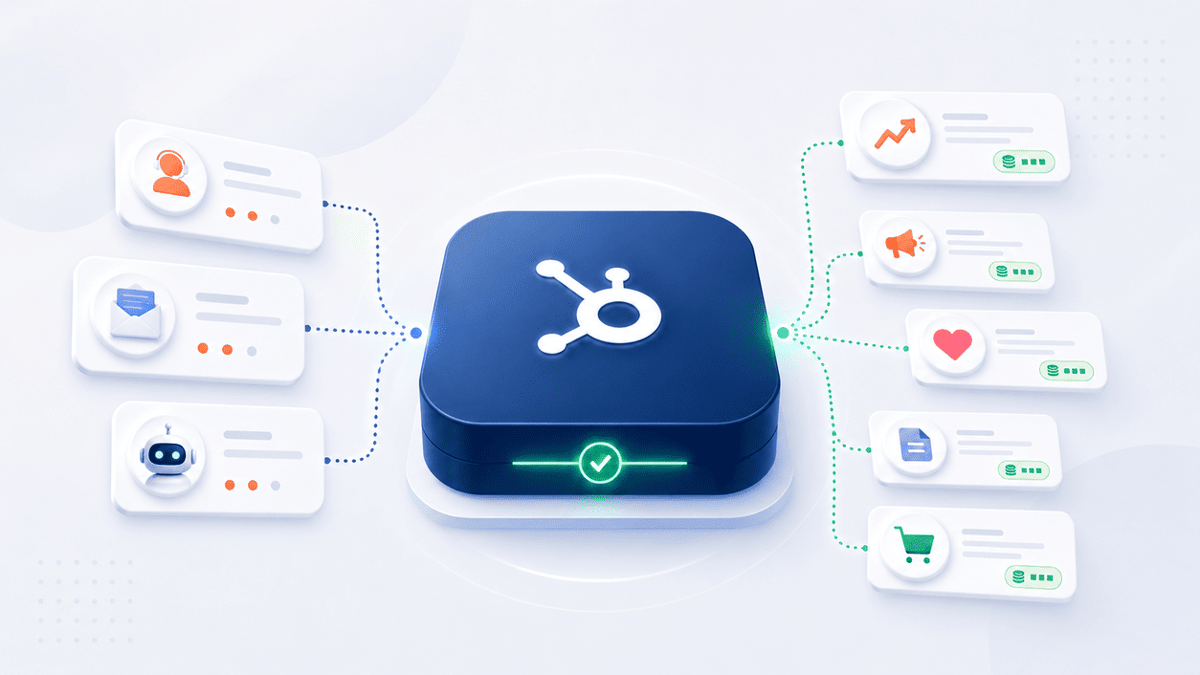
Short answer: HubSpot is best suited when marketing, sales and service need to be on the same platform with predictable growth. Salesforce suits large organizations with complex processes and budget for implementation. Pipedrive suits sales teams that primarily need pipeline - not full inbound marketing. HubSpot's new pricing model (2026) is simpler than before, but credits and seats still require planning. Read all about it in the Full guide on HubSpot's new pricing model
Comparison at a glance (Nordic B2B)| Criterion | HubSpot (2026) | Salesforce | Pipedrive |
|---|---|---|---|
| Primary strength | Inbound + CRM + automation in one | Enterprise CRM and customization | Simple sales pipeline |
| Pricing structure | Edition + Core/Front Office seats + credits | Many clouds and add-on products | Per user + add-ons |
| Marketing | Strong native (email, landing pages, workflows) | Often Marketing Cloud separately | Weak / via integrations |
| Implementation time | Weeks-months (depending on release) | Often months-years | Days-weeks for sales |
| Hidden costs | Credits, onboarding, contact limits | Licenses, integrations, consultants | Add-ons, integrations |
| Typical B2B size | 10-500+ employees in growth | 100+ with dedicated admin | 5-100 sales reps |
HubSpot in 2026 - what's different?
HubSpot has removed much of the "hub wall": you choose Starter, Professional or Enterprise and get access to the hubs in that edition. Price drivers:
- Core and Front Office seats.
- Marketing contacts (not all CRM rows)
- HubSpot credits for AI and certain actions
For Nordic companies that want one truth for leads from LinkedIn, website and email to sales follow-up, this is often the most efficient model - read if the prices are actually cheaper.
Salesforce - when it's the right choice
Choose Salesforce when:
- You have complex sales processes(many objects, territories, approvals).
- IT and CRM admin are established teams, not "the one marketing manager".
- Your budget can handle a long implementation and ongoing consultants.
The challenge for growing Nordic B2Bs: total cost and time to value. Marketing and service often require separate products - not the same package as HubSpot Customer Platform.
Pipedrive - when it's the right choice
Pipedrive often wins on simplicity for sellers. It fits when:
- Marketing is run in other tools (possibly just LinkedIn + website).
- Your team is less than ~15 salespeople and needs quick pipeline discipline.
- You are not planning heavy marketing automation in the same system.
When marketing and sales grow together, many end up switching or stacking multiple tools - it should be part of the overall economy.
Recommendation by situation
- Growth B2B, inbound + sales in the same team: HubSpot Professional is often the sweet spot - see release guide.
- Group/enterprise with ERP-heavy integration: consider Salesforce, but calculate total cost.
- Pipeline discipline only, little marketing: Pipedrive can hold - until strategy changes.
Before deciding: review 4 questions before buying and our complete HubSpot guide.
Read also in the HubSpot series
Need help choosing? We help Nordic B2B companies with HubSpot setup, license selection and implementation.
Frequently asked questions
Is HubSpot cheaper than Salesforce?
Often lower entry and faster value for mid-sized B2B. Enterprise Salesforce with multiple clouds can outperform HubSpot overall - compare equal feature levels.
Can Pipedrive replace HubSpot?
For pure sales management yes. For email marketing, workflows, CMS and service in one place - no, unless you accept many integrations.
What is HubSpot's biggest weakness vs Salesforce?
Extreme enterprise customization and complex B2B2C models. For most Nordic B2B growth companies, HubSpot is more than enough.
Should we choose HubSpot just because the price looks simpler?
No, we shouldn't. A simple pricing model helps, but you still need to map seats, contacts and credits - otherwise "simple" pricing still becomes unpredictable.
Next step
If you want to make this concrete for your company, start with a short review of goals, CRM data, content and follow-up.
Frequently asked questions about HubSpot, Salesforce and Pipedrive
Which CRM is best for a growing B2B team?
HubSpot often fits teams that want sales, marketing and service in one operating system. Salesforce fits more complex enterprise environments, while Pipedrive is simpler for sales-led teams.
What should you compare beyond price?
Compare implementation effort, reporting needs, integrations, admin capacity and how quickly the team can adopt the system.
When should you avoid switching?
Avoid switching when the real issue is process, ownership or data quality rather than the CRM itself.